
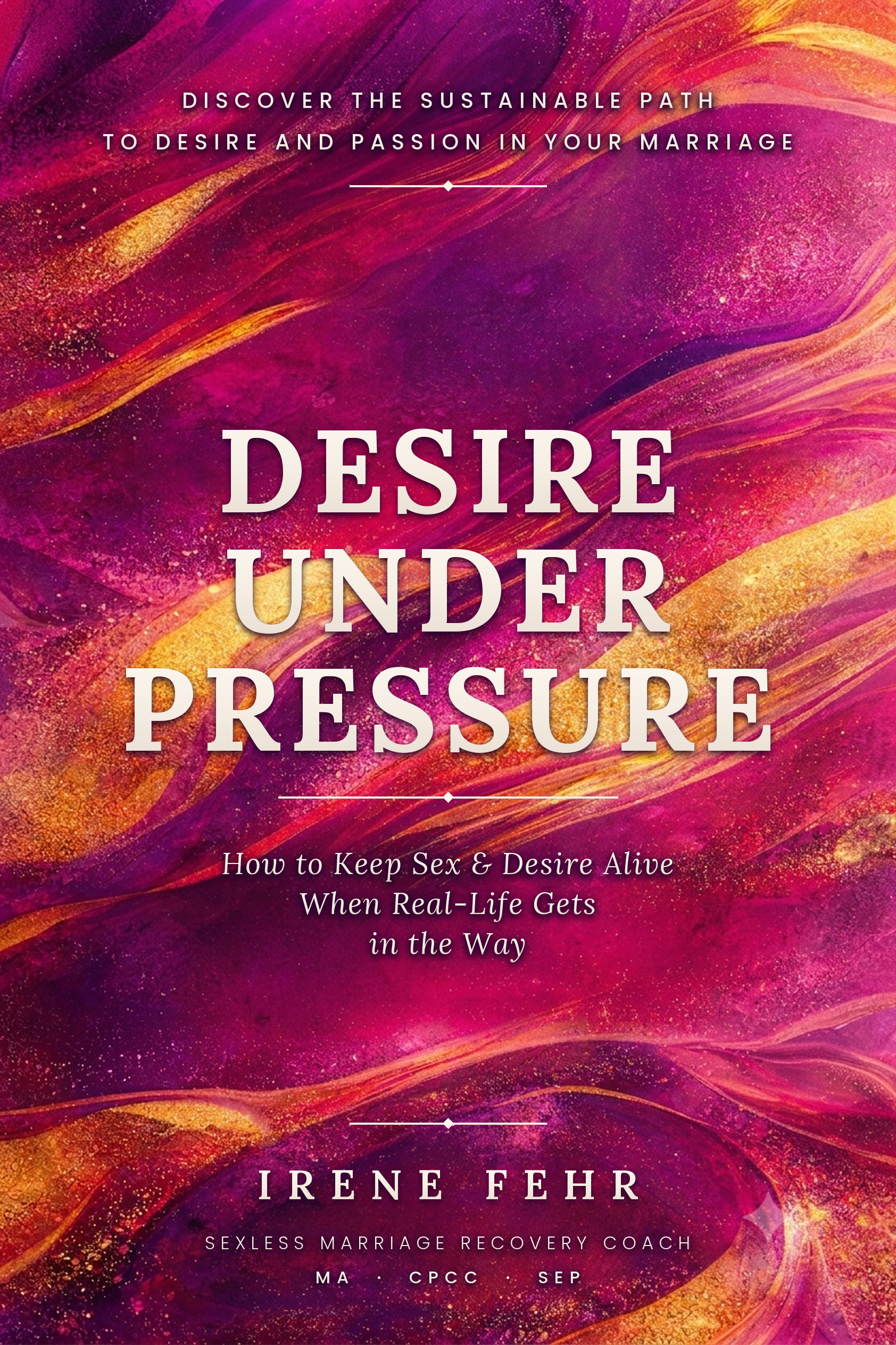
Desire Under Pressure:
How to Keep Sex & Desire Alive When Real-Life Gets in the Way
Mismatched libidos get the blame for a sexless marriage. What if the pressure cycles are the real cause?
Work. Kids. Stress. A to-do list that never ends. Somewhere along the way, sex went from fun to pressure — and trying harder only makes it worse.
Desire doesn't disappear because you want different amounts of sex. It gets lost amidst pressure cycles, the compounding patterns that quietly turn lovers into opponents and touch into a test. Until you see them, you can't change them.
Stop blaming mismatched libidos and start looking at the cycles instead.
This book shows you:
Five pressure cycles that consume couples
How they keep you stuck
How to loosen them via practical steps that work with demands of work and family life — without adding more pressure.
Coming at the end of 2026.
Get launch details + forthcoming free chapter!
Be the first to read excerpts and receive updates on the book launch.
Mismatched Libidos Are One of the Most Normal Things About a Long-term Relationship
Research published in the Personality and Social Psychology Bulletin found that up to 80% of couples regularly experience a desire discrepancy: a daily or weekly situation where one partner wants sex and the other doesn't.
This is normal. Partners rarely want sex at exactly the same frequency. Our bodies, histories, beliefs, and past experiences all shape how desire shows up. Desire levels often fluctuate or decline more steeply due to life stressors (like childbirth or the domestic mental load). Trauma can change how a person's body responds to desire altogether.
So why does this perfectly normal and ordinary difference so often turn into a sexless marriage?
A survey of 1,054 married couples in Archives of Sexual Behavior found that desire discrepancies predicted lower relationship stability, poorer communication, and more conflict. That’s because nobody teaches us how to navigate this.
However natural, having differences between each other doesn't make it easy. Being the one who wants more again and again hurts. Being the one who wants less, and feeling the weight of it, hurts too. Couples get stuck in cycles of frustration, disappointment and pressure — and naturally this leads to loss of emotional safety, poorer communication and more conflict.
Learning to navigate differences and conflict is a relationship skill that few of us get to learn. No one shows us how to say what we need without it sounding like a demand. How to share disappointment without it landing as blame. How to say no without it feeling like rejection. So we do what anyone would do with frustration and no tools. We push, or we pull away. We go quiet, or we go on the attack.
And that's how a common and natural difference in libidos becomes an emotional pressure cycle that starts to deteriorate the rest of the relationship.
Desire Isn't Lost in a Vacuum. It's Destroyed by Pressure Cycles.
Most couples are never caught in just one pressure cycle. Many are caught in all five, with each cycle feeding the others.
The cycle that turns you into enemies.
The more one of you pursues, the more the other retreats, and the more one retreats, the harder the other pursues. Each of you reads the other's behavior as proof that something is wrong with them, or with the relationship. You start avoiding touch because you know where it might lead. You stop initiating because rejection hurts too much. You become more careful, more guarded and less affectionate, until resentment replaces connection and you stop feeling like partners and start feeling like opponents.
The cycle that turns every touch into a test.
One partner wants more sex. The other feels pressured and pulls away. The withdrawal creates more frustration and urgency, which creates more pressure, which leads to more retreat. Before long, touch feels loaded, rejection hurts more deeply, and the same "sex argument" plays on repeat. Eventually, couples aren't just having less sex. They've lost the emotional safety that makes desire possible in the first place.
The cycle that happens when everything else comes first.
Career. Kids. Aging parents. A calendar that never empties. Somewhere in the middle of building a life together, you stopped having time to be lovers, and no one said it out loud. The less lover time you have, the heavier the emotional cycle gets, because every missed chance to connect raises the stakes on the next one.
The cycle that nobody talks about: the mental load.
Who carries what. Who notices. Who feels supported, and who feels like they're doing it all alone. When appreciation goes missing, couples emotionally harden towards each other, which makes connection even harder.
The cycle that has you trying harder while nothing changes.
If sex doesn't feel good, it's normal to pull away. It’s reasonable to want to avoid going back to something that feels awkward, disconnected, or disappointing — much less painful and unpleasant. So the harder you try — the more effort, more planning, more talking, more searching for a new technique you — it actually puts more pressure on you and your sex life. It becomes yet another vicious cycle: the harder you try, the more pressure there is, and the less safe and good it feels the next time around.
You may recognize yourself in one of these cycles instantly — or all five. They work together to compound and amplify each other, placing more and more pressure on the relationship and desire.
About the Book
Desire Under Pressure is not another book on how to have more sex by trying to have more sex. This book shows you what's really going on with the pressure cycles — and what to do about it.
Desire Under Pressure offers a grounded, embodied approach to rekindling sexual desire in long-term relationships — especially for couples navigating the realities of modern life: careers, parenting, stress, and emotional fatigue.
It's a way of seeing your marriage differently. Once you can name the cycles, you can't un-see them. And couples who can see the cycle can finally stop fighting each other and start changing it, together.
Inside, you'll discover:
Why desire naturally changes shape in long-term relationships — and why it is not a personal failure
How stress, exhaustion, and mental load shape sexual shutdown in the nervous system
Why the same argument keeps repeating, and the one thing neither of you is saying
How to identify which pressure cycle you're in right now and how to break its power over your relationship
Why "just prioritize intimacy" so often backfires, and what creates real space for it that is sustainable and nourishing
What your partner's withdrawal (or pursuit) is actually protecting and how to feel safe with each other again
Where to begin, so that change feels like relief and not another thing to do
How to stop trying to “fix” your sex life and instead create the conditions for desire to return
How to reconnect with your sexuality in a way that restores aliveness, sensation, and pleasure
Ways to rebuild intimacy with your partner without pressure, performance, or forcing outcomes
The path to experience desire again — even in the midst of a full and demanding life
(No spoilers. The chapters are where it gets specific.)

About the Author
Irene Fehr, MA, CPCC, SEP, is a somatic sex and intimacy coach and nervous system-informed practitioner specializing in desire, disconnection, and relational repair in long-term relationships.
Her work integrates somatic practices, nervous system science, and modern tantric approaches to help couples move from pressure and disconnection back into intimacy and aliveness.
Her writing and work have been featured widely, including in her viral Huffington Post essay “What I Learned from My Sexless Marriage” that spoke to a reality many women quietly face: losing sexual desire in an otherwise happy, loving partnership.
She has appeared as an expert in hundreds of media articles around the world as well as in 40+ podcast interviews, including:
Sex Reimagined Podcast
Empowered Relationship Podcast
The Love Lab Podcast
Sexology Podcast with Dr. Moali
Sexy Marriage Nation
Get launch details + forthcoming free chapter!
Be the first to read excerpts and receive updates on the book launch.